Labour is back in a major way, wielding its majorly moderate policies.
If elections could be won on hype alone, the Labour Party should enjoy some pretty smooth sailing from here until election day. It’s riding on a high, following a string of some pretty agreeable policy announcements, and a strong run in post-Budget polls – for the first time in the MMP era, Labour could bring on a one-term government.
In reality, the winds of change are rarely so easy to navigate. The 500 party faithful who attended the party’s annual conference – sorry, that’s “congress” in an election year – at Wellington’s Tākina Convention Centre were battered by wind and rain as events commenced on Saturday. But even if the wild weather dampened some spirits, by Sunday, its membership had fire in their bellies. What the previous weekend’s National Party conference lacked in exhilaration, Labour’s congress had in spades.
There were hundreds of hands waving party banners in the air as leader Chris Hipkins took the stage to declare “the fight is on”. His supporters received his message with ample enthusiasm – they’d just been warmed up with a performance from a Wainuiomata kapa haka rōpū, and the strobe-lit scene made the whole thing feel like a daytime rave. If there’s anything a Labour Party event can do well, it’s emulating the vibe of a church youth conference.

To a full room, Hipkins painted a picture of a nation going backwards: the cost of living crisis is relentless, our young people are going overseas and working hard hardly means anything any more. The coalition government is so heartless that it even counts Fair Go as one of its casualties, Hipkins would have you know.
For a moment, he even channelled former US Republican president Ronald Reagan and reduced the campaign to the age-old question: “Are you better off than you were three years ago?”
“Is the weekly shop any easier?” he asked. “Are your power bills any lower? Is it any easier to get a doctor’s appointment? Are your kids and grandkids choosing to live here?” You’d be pretty hard pressed to find someone who could honestly answer “yes” to any of those questions.
But at the same time, over 640km away in Auckland, Act Party leader David Seymour was leading his supporters in a chant of “lock Labour out”. Elsewhere in the country, NZ First leader Winston Peters assured supporters, for the umpteenth time, that his party will not be siding with Labour (“So the media can stop asking me gripper questions. You know what a gripper is don’t you? It’s a wanker that won’t let go.”) There’s plenty of noise on both sides.

Despite all the hype, the party’s final act of the day was less about spectacle and more about restraint. Hipkins pledged a reset to the Apprenticeship Boost scheme back to two years (National rolled back the $500-a-month fund for employers to one year in 2025), alongside a $1,000 grant for apprentices to kit out their toolboxes, and a funding boost will allow the Industry Skills Board to scale up mentoring. Much like the voters the party is trying to win back, Labour’s approach is more practical than transformative, and these pledges will rely on the party’s proposed capital gains tax for funding. At this point, that tax is beginning to look like the party’s bottomless pot of gold.
It’s Labour’s first education policy of the campaign, and Hipkins preferred to not give anything away when asked by The Spinoff whether a return of the Fees Free scheme was on the table. “This is our policy on apprenticeships,” Hipkins replied. “We’ll set out other tertiary policies as we go along.”
The challenge now is whether the party can shake off the déjà vu. It wasn’t so long ago that Labour was trying to capitalise on the disappointments of a National-led government into a winning campaign. This time around, however, it’s a party more keen to emphasise quiet competence than total transformation. But that method hasn’t exactly panned out well for Labour’s sister party in the UK.
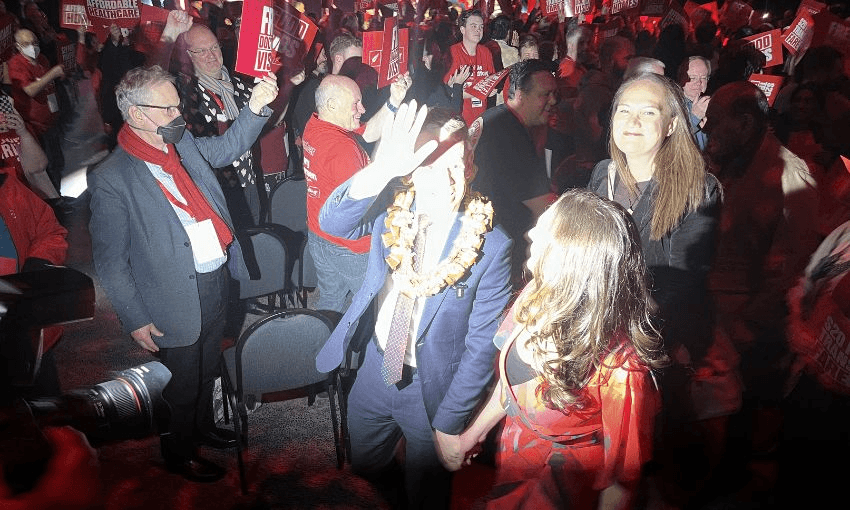
While party president Jill Day’s call to “campaign with kindness” in her address to members on Saturday may have had some glimmers of the recent past, Hipkins is more cautious. “It’s gonna be a robust campaign,” he told reporters. “I certainly hope there can be some kindness and compassion in it. I think this is a government that’s totally been lacking in both.”
When you’re not being blinded by the strobe lights and the vision isn’t obscured by slogans, the picture is pretty modest: jobs, health, homes. The spectacle is perhaps less about the party itself and more about potentially bringing an end to a particularly unpopular government – even if that means going down the more moderate track.