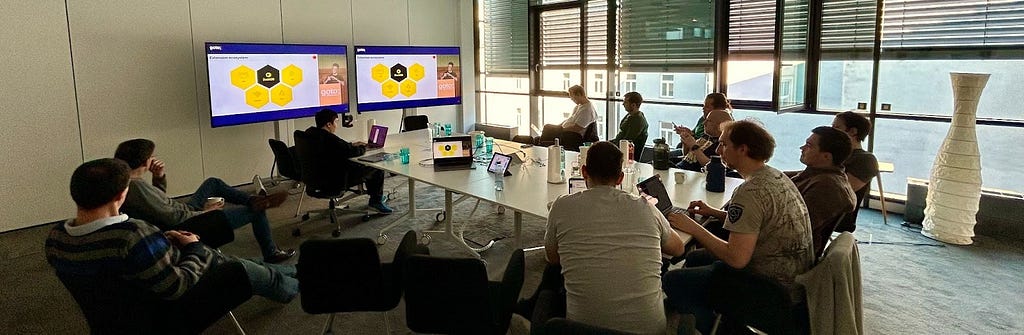
At willhaben, every employee in tech has a time and money budget to spend on conferences, training and courses. Many of us like to go to conferences (like KubeCon, CodeCrafts Vienna or UXDX Berlin this year) but since many of the most attended talks are available online for free, every now then we take some time to select the talks that interest us most and watch them together in the willhaben office and have a discussion about it afterwards.
These are the talks that made it into our selection and some comments and discussion points we had about them.
Talk 1: What’s the Best Big Data Architecture for You? • Christoph Windheuser • GOTO 2024
Very high level and generic talk about how a modern data architecture could look like
Main takeaways
- Moving Data Products into business units has advantages
- In Data Meshes, data transformation units can be connected like lego
- willhaben data architecture looks very similar to the one presented
- Suggested to use data meshes for large companies (which we are not)
- Beliefs in AI (e.g. Natural language to SQL), but it still has many flaws in our opinion
- It’s very high level, slow and hard to excite yourself for it
Learned something new?
- Speaker seems to think AI will replace a lot of tasks (“AI runs your company”)
- It was an interesting overview of the state of the art for people not familiar with data architectures
Rating: ⭐⭐⭐
Talk 2: The software engineering industry in 2024: what changed, why, and what is next
How are financial markets and interest rates connected to startups, innovation and the job market?
Main takeaways
- Aim for career-security, not job-security.
- Product minded developer
- Shift Left: Devs do more and more things (development, testing, releases, maybe even project management)
Worth your time? Learned something new?
- Impact of interest rates onto the US market and innovations (but over-explaining the whole thing)
- People are less risk-taking then before ➡️ more documentation, more specification before hand, less iterations, etc.
- Use boring technology vs. shiny new things
- Heavily US focused (keep that in mind when watching), so career and job analysis can not be directly compared to EU
Rating: ⭐⭐⭐⭐
Talk 3: A Field Guide to Reliability Engineering at Zalando • Heinrich Hartmann • GOTO
Deep dive into Zalando’s monitoring and alerting system and processes. They have about 3000 microservices and about 2000 employees, so they better have good monitoring systems in place 🙂
Main takeaways
- Obsess about User Experience
- Symptom-Based Alerts (User Experience) are better than Causes-Based Alerts (Server Experience)
- Adaptive Paging based on User Experience
- Alert severity definition by examples (e.g. AWS region is down ➡️ severity 1)
- Decoupled Alerting/Reporting SLOs
- CTO, Vice President and Director take part in the on call post mortem meetings
- “We had failures of 500 Mio in the last quarter” is easier sell than “I’ve got the feeling we should fix this bug”
- Dashboard should reduce time to repair
- They don’t have a good system for monitoring data quality in place
- Product SLOs on each use case for a 7 and 30 day period.
- Managerial and Team Alerting are different and should be separate
Worth your time? Learned something new?
- Elaborate processes and very impressive alerting and monitoring systems
Rating: ⭐⭐⭐⭐⭐
Talk 4: 🦆DuckDB: Crunching Data Anywhere, From Laptops to Servers • Gabor Szarnyas • GOTO 2024
DuckDB, one of my most favorite tools for developers, can “crunch the numbers” for Gigabytes of data on your local laptop. It is free, open source and can import and query a great number of data formats like JSON, Parquet, CSV, etc.
Main takeaways
- It would be interesting to compare DuckDB with sqlite
- Lot of interesting functions like SQL Pivot directly baked in
- Truly serverless and only a single (binary) file
- Advertised as local snowflake alternative
- Interesting what happens under the hood: Vectorized execution (enables batch processed), Zone maps
- Portability by inlining/vendoring dependencies
Worth your Time?
- I’d recommend it. It’s interesting, what you can do on your local laptop with DuckDB
- Technical and very interesting for developers
Rating: ⭐⭐⭐⭐⭐
While going to a conference in person is for sure more exciting, you can’t watch all interesting talks that happen in a year. The Dev Cinema format is a nice way of watching and discussing talks with your colleagues.
Backlog of yet unwatched other talks
- Fei Fei Li, Professor, Stanford University on the History and Future of AI at Data + AI Summit 2024
- SQLite: How it works, by Richard Hipp
- “How to Make Your Website Not Ugly: Basic UX for Programmers — Hilary Stohs-Krause”
Dev Cinema was originally published in willhaben Tech Blog on Medium, where people are continuing the conversation by highlighting and responding to this story.