It was one of the biggest tech headlines in June: Amid the race leading up to the initial public offerings (IPOs) of artificial intelligence (AI) giants, the United States used its “blocking card” to disable Anthropic’s latest models. Citing national security concerns, the Trump Administration forced the company to prevent non-U.S. citizens (even in the US) from using its most advanced models — the very ones it had just unveiled. Speculation suggests the same thing could happen to OpenAI.
The ban on Anthropic was not lifted until June 30. The US administration said that, in the intervening weeks, it had worked with the company to “review and approve Fable5 to ensure it aligns with the US government and strengthens US leadership in AI.” For its part, OpenAI confirmed that its next major launch would begin with a preview for “trusted partners ”—a list it has shared with the US government.
Are these companies falling victim to their own marketing — having touted that their models are becoming increasingly intelligent and potentially more dangerous? Or are they collateral damage in an uncertain geopolitical world? Whatever the rationale, the recent moves raise questions in Europe, where digital sovereignty movements are on the rise.
The sudden shutdown of Fable 5 and Mythos 5 for European companies had a limited direct impact, because the models were so new. As Fernando Maldonado, senior analyst at Foundry Spain, noted: “Hardly anyone here had even started using them yet.” The indirect impact is more far-reaching, because it shows that a forced technological blackout is possible and that Europe has a limited margin for response.
The doomsday scenarios warn that Europe could be headed for a future tech disaster that will have a domino effect on the economy and society. That’s the conclusion of the “Europe 2031” report, prepared by a group of European AI researchers, analysts, and investors. “The current trajectory of AI calls for the most ambitious political agenda in the history of postwar Europe,” the report concludes. They argue that Europe has failed to grasp the scale of AI ‘s spread and warn that Europe couldl fall into irrelevance. (The group estimates that, in that scenario, the continent would control only 5% of AI computing by 2031, compared to 80% for the US). There is much talk of sovereignty, but little real-world action so far.
That dystopian vision of the future coexists with other, more nuanced perspectives. But analysts and political scientists point out that AI could yet become an economic and political lever that will shape the future balance of power.
The ‘kill switch’ scenario
The total shutdown “kill switch” option, deemed impossible not so long ago, has established itself as one of the real potential fears in geopolitical risk: it was on the agenda at the recent G7 meeting. The Anthropic case was seen as a warning. “Technology is increasingly a strategic asset. Europe must be able to act on its own terms,” European Commission spokesperson Thomas Regnier told Euronews. Speaking to Reuters, he added, “This event is further proof that Europe must strengthen its technological sovereignty.”
The Anthropic outage “has given ammunition to those who have been calling for investment in technological sovereignty and highlights this geopolitical situation,” said Beatriz Arias, director of digital transformation at DigitalES. Arias believes the incident shows that today’s reality requires work in more areas; it is no longer enough to manage telecommunications or standards. Other issues such as interoperability and intellectual property are on the table, as well as “the need to invest more in our own capabilities, without prejudice to our continued commitment to an open model of cooperation and alliances.”
That said, Darío García de Viedma, a researcher in Technology and Digital Policy at the Elcano Royal Institute, does not believe the feared kill switch will be used, “because the US technology export model depends on companies. Companies are the strong arm of US diplomacy in the technological sphere.” For them to play that tole, they need a global presence. But he does agree that what happened with Anthropic helps “explain this risk to the public” — and incidentally showcase what technological sovereignty is.
Even if a catastrophic blackout doesn’t occur, other problems could still hinder access. Political scientist Amélie Férey explained on France Culture how license prices could gradually rise and drive up costs. Or access to certain features could be gradually restricted. As García de Viedma put it, a moratorium on model access would create a “temporal asymmetry.” Disruptions can occur in “the complex supply chain behind all our technology,” through export controls (something now happening in the chip market) or through the degradation of essential services (such as what could happen with Starlink coverage).
In recent years, the European Union has entered a race in that arena, one that involves symbolic measures well as practical legislative moves. The European Parliament has dropped Google as its default search engine and replaced it with the French Qwant. And in early June, the Commission presented its European Technology Sovereignty Package, which addresses, among other issues, AI. They aim to ensure that Europe becomes “a continent of AI, strengthen its digital autonomy, and help build a more sustainable digital future,” while also acknowledging Europe’s technological dependence.
“We cannot afford to depend on others for the technologies that keep our hospitals running, our energy grids stable, and our services secure,” said Commission President Ursula von der Leyen. Specifically, Europe aims to triple the capacity of its data centers over the next five to seven years, boost the adoption of AI, enhance research and innovation, and work on its own development and deployment efforts. The package will now have to go through an approval process to become law and take effect.
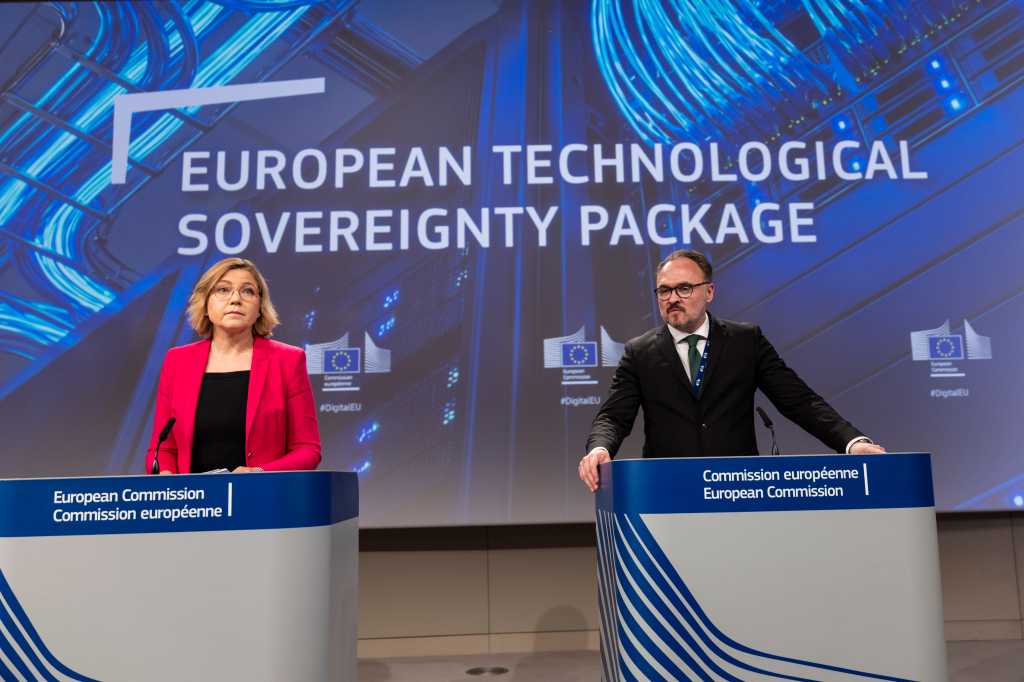
Henna Virkkunen and Dan Jørgensen at the presentation of the EU’s technological sovereignty package on June 3.
UE
Has Europe done enough?
The big question is whether what Europe has done — and what it plans to do — will be enough. Are the sovereignty packages sufficient, or are they vague and lacking in concrete details? The Europe 2031 group accuses Europe of making empty promises that don’t translate into tangible results.
García de Viedma said the latest package represents “good progress, which is defining technological sovereignty as risk mitigation.” In this case, risk has three aspects: technological dependence could be used as a coercive measure; tech operations could be disrupted “if at any point our alliances deteriorate;” and IT could be used as a tool for surveillance.
“Not to sound like conspiracy theorists, but the fact is that there is a possibility that whoever controls the communication nodes and software has the ability to see, if not everything, then at least some things,” he said. “That gives them an advantage.” Therefore, sovereignty is not so much “that identity-based vision” but rather one of “risk avoidance.” It’s not about using European technology simply because it’s European, but about understanding the risks of not using it.
Viedma believes the Commission has accurately identified today’s problems (such as governance or the digitization of the power grid, “the main bottleneck for AI”) but wonders about the future. Added to this is the issue of money: investment is a key piece in this chess game.
DigitalES views the efforts currently under way — such as those regarding European chips — favorably. “What’s needed is more determination and focus,” said Arias. Incidents like the Anthropic case can “help move in that direction.” While European investment plans in AI may seem less grandiose than those of the sector’s major companies, Arias warned against defeatist rhetoric.
“The EU is doing what it needs to do,” he said, and is creating “a more geopolitically stable environment for investors. Ultimately, this is about the market and who creates the most value.” European regulations can eventually become global standards, with Europe positioning itself “as an attractive partner for investment” — one that is “reliable and more predictable.”
Arias said the key lies not in complete autonomy, but in finding a balance. “We don’t have to produce 100% of what we use, and we shouldn’t depend 100% on a single supplier or jurisdiction.” What’s needed is technological diplomacy, being able to navigate complex waters and safeguard interests.
Playing by different rules in the global AI market is not feasible. “You must be aware of your strengths and weaknesses.” And she insists: “Europe is by no means a long shot — quite the opposite, because it offers certain guarantees.”
The next great revolution
Europe is late to the AI race, but it can still “assume a certain leadership role,” depending on how the sector evolves, as García de Viedma notes. Europe can carve out its own niche and investments are being made and efforts are under way to do so. In AI, this involves identifying areas of European specialization.
There remains a lot of work to be done and, possibly, lessons learned from past experiences to face what lies ahead. AI issues are part of a very complex reality. Arias warned of the need to prepare for “the convergence of artificial intelligence with the computing power that quantum computing will provide” featuring “dual-use technology that will be employed for both military and civilian purposes.” These will be more powerful tools that “require a more solid foundation.
“Such technological diplomacy will be necessary to negotiate global quantum standards, protect intellectual property, and address the potential impact on national security.”
The quantum revolution is imminent, but has yet to unfold, and Europe can capitalize on it. “Europe is jumping on this bandwagon,” argued Arias, highlighting the investments and work on quantum capabilities. “We’re in a very different situation than we were with the cloud and artificial intelligence.” The EU is “acting quickly” and opening the door to “positioning ourselves country by country.”